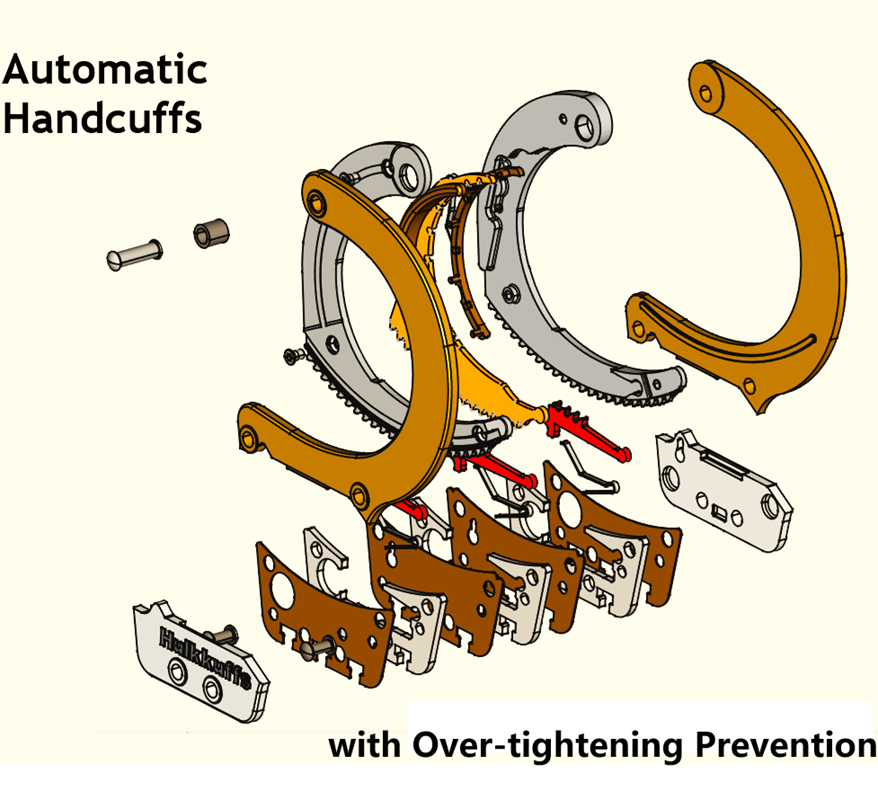
Determining whether a handcuff uses an automatic or manual mechanism primarily depends on how the double lock (which prevents further tightening) is engaged.
Manual mechanisms: Require the user to manually engage the double lock by pressing a pin or sliding a lever on the handcuff body.
Automatic mechanisms: Engage the double lock automatically once the ratchet reaches a certain level of pressure, and typically do not include an external manual lever.
Here is how to verify the mechanisms:
- Identify the Double Lock System
Manual Mechanism: Look for a small pin, button, or lever on the edge of the handcuff, often referred to as a “plunger” or lever lock. It must be pushed inward using the back of a handcuff key (the actuator) or a fingertip.
Automatic Mechanism: These designs typically do not have an external push-pin or lever. Instead, the double lock is self-engaging, activating automatically during application to prevent over-tightening and reduce the need for fine motor precision in high-stress situations
- Physical Inspection (“Test Click”)
Manual Test: Apply the handcuff. If it continues to ratchet tighter (“click, click, click”) after it is firmly on the wrist and only stops once a pin or lever is manually engaged, it is a traditional manual cuff.
Automatic Test: If, during application, the cuff stops tightening at a certain pressure point without the need to engage a separate button or lever, it is likely an automatic mechanism.
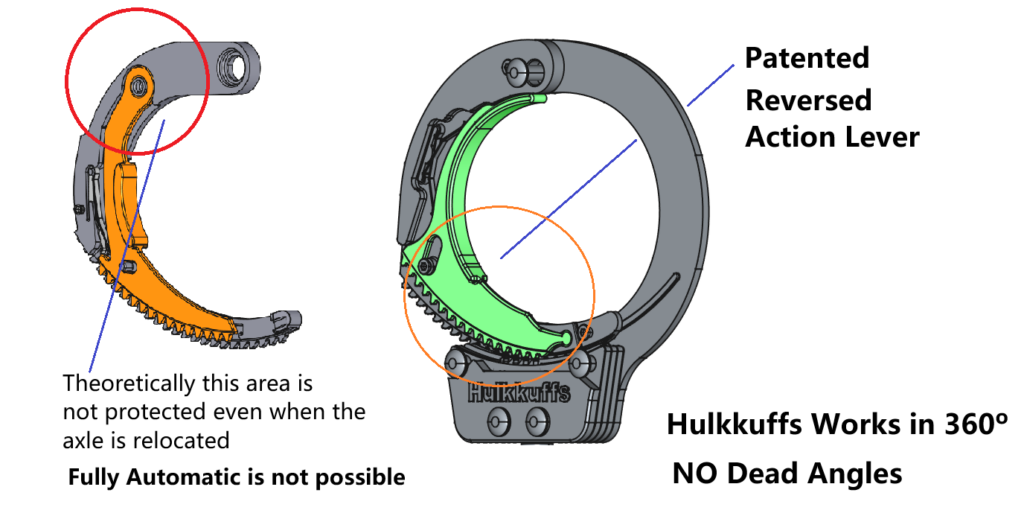
It can be seen that the rotational axes of the middle ratchets function differently. In the left-side design shown in the illustration, full protection can never be achieved, regardless of whether the middle ratchet is shorter or longer, or where the rotational axis is positioned. In certain angles, activation is theoretically impossible.
Conclusion
Manual: The specifications clearly state that a manual action (such as pushing or flipping a lever) is required to fully secure the handcuff.
Automatic: The specifications do not describe any manual action required to fully secure the handcuff.
Manual and automatic mechanisms are distinct and do not overlap in design, although marketing materials may sometimes blur the distinction or use exaggerated claims. Always review the technical details carefully