Questions & Answers
Q1: Do we need to change handcuffing SOP (standard operating procedures) during training or operations?
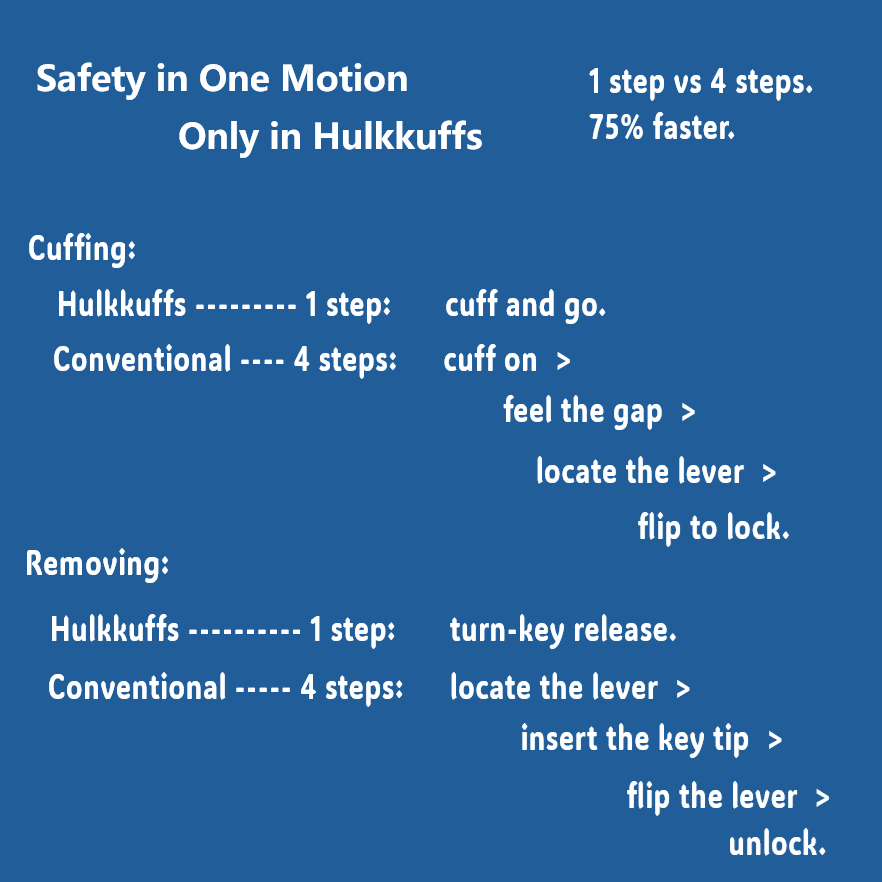
A1: No. Hulkkuffs are designed to fit current handcuffing SOPs. They help reduce physical strain during application, speed up the overall process, lower the risk of escalation, and allow officers to maintain better situational awareness and focus on safety.
Q2: Will the handcuffs malfunction if the tension mechanism fails or becomes obstructed?
A2: No. The over-tightening prevention mechanism only activates after the single strand is fully engaged. In other words, the system is triggered only once the primary locking mechanism is 100% engaged.
Q3: Will the handcuffs over-tighten if the tension control fails?
A3: No. In the event of a failure, the system may behave like a conventional handcuff. The mechanism is only activated after the handcuff is firmly applied to the wrist, meaning it does not operate before full engagement of the single strand. In most conditions, the over-tightening prevention system is more reliable than a manual double-lock.
Keep officers’ eyes on the situation, not the lock.
Hulkkuffs simplifies the handcuffing SOP without changing established procedures.
Q4: Can the tension control prevent the handcuffs from being opened? For example, will the handcuffs fail to release if the system is compromised?
A4: No. The stop pawl mechanism is one-directional and spring-loaded. It does not create resistance in the unlocking or loosening direction under any condition; resistance applies only in the tightening direction after activation.
Q5: Do Hulkkuffs require regular lubrication?
A5: No. The handcuffs are factory-lubricated and require no routine maintenance. Additional lubrication is not recommended, as improper lubricants may attract dirt and debris and interfere with proper operation.
Q6: Why do aluminum alloy handcuffs cost more than steel handcuffs?
A6: Aluminum alloys such as 7075 and 6061 are relatively soft before heat treatment. To achieve high strength, they must undergo precise thermal processing (tempering), which is time-consuming and requires specialized expertise. The resulting materials (7075-T6 and 6061-T6) offer a very high strength-to-weight ratio.
Q7: Are all aluminum alloy handcuffs better than steel or stainless steel handcuffs?
A7: Not necessarily. Performance depends on material treatment and design. Untreated aluminum alloys are too soft for structural use in handcuffs. Only properly heat-treated alloys such as 7075-T6 and 6061-T6 are suitable. When correctly processed, they can offer a higher strength-to-weight ratio than many steel or stainless steel options.
Q8: What precautions should be taken when operating Hulkkuffs?
A8: Always ensure the key is readily accessible. Standard handcuff keys may not be compatible for removal depending on the configuration.
Q9: Will the mechanism malfunction if jammed by dirt or debris?
A9: It is unlikely. If obstruction occurs, the system functions like a conventional handcuff. The design has been tested for reliability, with no failures observed in the first 10,000 cycles under controlled testing.
Q10: What does it mean that Hulkkuffs are 70–80% faster than conventional handcuffs?
A10: The time reduction refers to the full application-to-secure-lock and removal process under standard conditions. In high-resistance situations, the difference can be even more significant. This is about improving safety outcomes, not just saving time.